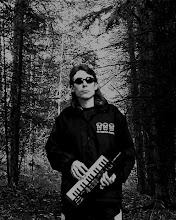
Vocaloid, in case you're not aware by now, is software developed by Yamaha that allows musicians to program vocal tracks for an ever-growing selection of virtual singers. Probably the most famous of these is a vocaloid called Hatsune Miku. It was a song by Miku (produced by Nayuta) called 'Silence' that first introduced me to vocaloid music. In fact it was the Nayuta vs TECHNiA remix, and that brings me to shu-t, who records as TECHNiA, Glint Of Sound, Feel The Sonic, and under his own name.
I found shu-t's album 'Various Feelings' on iTunes and it was the first vocaloid music I purchased. It showcases a varied selection of vocaloids so it serves as a good overview. The music is also fairly varied, while remaining in the techno arena. Vocaloids have been used on everything from garage-rock to symphonic music, but to me they're best suited to techno and trance, and that's why I think shu-t is one of the best vocaloid artists out there.
His basic setup is listed on his Myspace Page as the following:
Ableton Live 7, Image-Line FL Studio 8, Propellerhead REASON 3.0.
KORG Electribe MX, Kaossilator, Kaoss Pad 3, micro KONTROL.
reFX NEXUS2, KORG Legacy Collection - Digital Edition and Analog Edition 2007, YAMAHA VOCALOID, CELEMONY Melodyne.
I'll be featuring a selection of tracks by Shu-t, most of them uploaded to Youtube by the man himself, under the username: sonicwave2007. All videos are attributed to him unless otherwise noted.
Vox is a cool duet with some disco strings & house production. Watch out for the incredibly funky synth solos!
TECHNiA - Vox (vocals: Hatsune Miku, Meiko).
Unfortunately I couldn't find the album version of this remix, which is sung by Meiko and has much better fidelity. It's the most-played song on my iPod. The chorus lifts me into the stratosphere every time I hear it. I advise turning up your volume while listening:
Feel The Sonic - Whereabouts [TECHNiA remix] (Vocals: Megurine Luka) courtesy of Tatayatatana
This is quite anthemic. The album version also features Meiko so it has a little extra depth to the vocals. Another stunning solo played on a Korg Kaossilator:
Feel The Sonic - 4 Freedom (vocals: Luka Megurine)
Another stand out, this time with English lyrics throughout:
TECHNiA - Night of the Magic (vocals: Sweet Ann).
There are male vocaloids as well. To me they sound a little creepy. But the way "Gakupo/Gackpoid" is used in this track isn't bad (his vocal samples were provided by the popular Japanese singer Gackt).
Glint Of Sound - Cradle of Destiny [MG Style] (vocals: Meiko & Gakupo) courtesy of HatsuneMikuVocaloid2.
The following songs are from shu-t's album "AIMS." I'll start with an epic instrumental. A real stand out, and you can see some of his setup in the video.
shu-t - Delete Memory.
Megurine Luka was designed to sing in Japanese, but in this case she's singing English words. Not very intelligibly, it must be said, but vocaloids are such strange beasts that you can easily regard them as another instrument in the mix.
shu-t - Dream Grows (vocals: Megurine Luka).
Here's another track sung in English. If you click through to Youtube and view the video description you'll get the lyrics, which help a lot. It's obvious that English isn't shu-t's forte, but for me the mis-translation of the lyrics only adds to the appeal.
shu-t - Flaps The Wings (Vocals: Megurine Luka with Sweet Ann & Big Al).
I couldn't find the album version of this so here's an earlier version by TECHNiA. It's more dance-oriented than the album mix and has a different vocalist:
TECHNiA - @ Your Side (vocals: Sweet Ann).
Bonus track! The song that started it all. This is actually a mash-up of the original version of Silence by Nayuta and the remix by TECHNiA. Prepare for techno of incredible proportions!
Nayuta vs. TECHNiA - Silence [MMD Edition] (vocals: Miku Hatsune, Meiko) courtesy of kanna3939
I hope you've enjoyed at least some of these. Both "Various Feelings (shu-t's works)" and "AIMS" are available on iTunes in North America. I highly recommend them both.
I'd like to close by wishing everyone in Japan, including shu-t himself, the best in the wake of the recent disasters.
Saturday, March 19, 2011

Thursday, November 4, 2010
Feature: The Manitou - Let's Build Mecha! (2010)

Every so often here on Synthspotter I'll be featuring noteworthy (synthworthy?) independent releases. I'm kicking things off with an e.p. by The Manitou (otherwise known as yours truly).
"Let's Build Mecha!" features seven tracks, most of which were composed for Brokensea Audio Productions' "Doctor Who: Mechalution." It is of course the very same Doctor Who made famous by the BBC, in this case produced and written by and for fans who just can't get enough of the show.
There are a couple of moody experimental pieces on this release, but the rest is techno-pop with an industrial edge. The songs are crafted using sampled circuit-bent gear (such as a modified Texas Instruments Speak & Spell), synthesized & sampled percussion, a Novation K-Station analog-modelling synth, and a Crumar Performer string synthesizer.
Doctor Who: Mechalution, in a nutshell, is about a planet where robotic lifeforms are evolving out of the entropy left by its former inhabitants. The Manitou's music has investigated similar themes in the past, so it was fun to do an entire e.p. in that vein.
Best of all, the podcast episode is available for free at the Brokensea link above, and the e.p. is also free at www.manitouslair.com. To further entice you, here's a video promo:
The Manitou - Let's Build Mecha (Promo), courtesy of wireslave.
Enjoy!
Sunday, October 10, 2010
Thompson Twins - Into The Gap (1983)

Here's an album I recently rediscovered, and which was big with me when I was a kid. Into The Gap is certainly the Thompson Twins most successful album, and with good reason. The songs are catchy, well-executed, and full of diverse sounds and instrumentation. The band, at this stage in their career, consisted of:
Tom Bailey: vocals, synthesizer, piano, contrabass, harmonica, guitars, drum programming.
Joe Leeway: Prophet synthesizer, percussion, backing vocals.
Alannah Currie: backing vocals, drums, percussion, marimba, xylophone, backing vocals.
It was revealed in a 1984 issue of Keyboard magazine that 95% of the synth parts on the album are thanks to an Oberheim OB-Xa. A Prophet 5 and a Pro-One were also used, both manufactured by Sequential Circuits. (Thanks to Micke @ Vintagesynth.com forum for the info). Also of note is the rare Movement MCS Percussion Computer (which combined analogue drum synthesis and 8-bit digital drum samples with computerised sequencing) and the Movement Mimic (an early monophonic sampler with keyboard control) both made in Britain by Movement Systems.
Let's start with the opening track, "Doctor! Doctor!" which features some incredible moody synth sounds and an awesome multitracked solo.
Doctor! Doctor! courtesy of BlueBoy11035.
This is the song that most people remember, even though it charted lower in the UK (#4) than other singles from the album. Nevertheless, it's a fine song for a band to be remembered by. The 12" version is especially good, by the way. You can find it on "Thompson Twins Greatest Mixes," along with three other 12" singles from this album.
Hold Me Now, courtesy of miguelm0de.
This track's a little lighter on the synths, but was always a favourite of mine. You can hear the Mimic in action, providing some mechanical sound effects.
You Take Me Up, courtesy of Tabstarkin.
Five singles were released in total from the album - quite a number considering two or three is the norm these days. Sister Of Mercy was another ballad:
Sister Of Mercy, courtesy of Tabstarkin.
"The Gap" features eastern influences, more sampler action, and a whole lot of funk.
The Gap, courtesy of fery2.
Unfortunately I couldn't find the studio version of "Day After Day." Here's a live version instead, from their 1983 Into The Gap tour. Sorry about the sound quality.
Day After Day (live), courtesy of grupozaz.
Some great synth-brass on this track.
Who Can Stop The Rain, courtesy of goobiskii.
I'll round this post out with a slow number. I managed to track down all but one track from the album on youtube (actually "No Peace For The Wicked" can be found if you search for it, but embedding has been disabled for that particular track).
Storm On The Sea, courtesy of Reborninoktober.
I hope you've enjoyed!
Thursday, June 24, 2010
Dee D. Jackson - Cosmic Curves (1978)

What we have here is an oddity and an undiscovered treasure: a space-disco concept album. It works surprisingly well. Quaint spacey synth-sounds play off against funky rock-guitar and solid disco drum beats. Dee D. Jackson's voice alternates from angular, to angelic and beautiful, to strong and powerful throughout. The album was produced by Gary and Patty Unwin. Synths unknown.
Here's the opening track, Automatic Lover, which was a single and reached #1 in several countries. The only complaint I have about it is the faux-robot voice that repeats far too often. The video is suitably cheesy.
Automatic Lover, courtesy of bchfj
This blog is about synthesizer music, but ironically my favourite thing about this next track is the guitars.
Red Flight, courtesy of TheSupernaut76
Meteor Man, also a single, didn't do as well as Automatic Lover, but is another stand-out track.
Meteor Man, courtesy of Superdiscomania
Galaxy Police, courtesy of EldorAudio2
I'm so glad I could find this one on Youtube. The epic 'trial' which serves as the album's climax. Probably my favourite track.
Cosmic Curves, courtesy of valterik63
And finally, the album's closer, a poignant space-ballad.
Falling Into Space, courtesy of EldorAudio2
Cosmic Curves is released on CD this year (it may already be out), complete with bonus tracks. Highly recommended.
Wednesday, June 9, 2010
Special: Japanese Techno-Pop
Let me begin with a bit of back-story. Growing up in the 80s, with synth-driven music and its strong and catchy melodies, I spent most of the 90s thinking good music had come to an end. I listened almost exclusively to music from the 70s and 80s during that period, with few exceptions. Music TV and radio were my only sources for discovering new music, and try as I might, I just couldn't enjoy anything current.
Then, in 1999, Eiffel 65's 'Blue' was played on the TV. I'd never heard anything like it. I remember thinking that dance music had suddenly risen to new heights. The odd thing is, it's a very simple song - almost too simple. But the impact it had was enormous. Thanks to the internet, which was new to me at the time, I discovered that bands like Eiffel 65 were thick on the ground overseas. The problem was they weren't played on Canadian radio, nor were they likely to be unless they had a crossover hit.
Eiffel 65 - Blue, courtesy of blisscorporation
Another band that changed my outlook was Canada's Front Line Assembly. They too were absent from the airwaves. Nevertheless, I picked up a compilation of theirs called 'Reclamation.' It proved to me that good music had not died. They'd been making music since the early nineties, but was it being heard? Certainly not by me. And they weren't the only band out there making industrial synth-music.
Front Line Assembly - Provision, courtesy of MetalKael
A world of new music opened up to me. I no longer had to wade through angst-ridden 'alternative' bands pushing swaths of distorted fuzz around and singing dirges over the top of it. Thanks to these two bands, and the internet, I discovered electro-house, EBM, trance, funk, and many genres in-between.
Now, ten years later, I feel I've discovered the next 'revolution' in my musical tastes: Japanese Techno-Pop. My love for Anime has exposed me not only to the Japanese language, but also to the quirky, happy theme tunes. I knew about 'J-Pop' but never really heard anything that caught my attention. I'd been listening to Vocaloid music, specifically Hatsune Miku, and it was via Miku Channel blog that I discovered the band Perfume.
On the surface of it, Perfume are a 'girl group' that sing happy bubblegum songs. But beneath their auto-tuned voices lies a bed of exquisitely-produced techno-pop. The man responsible for writing and producing these songs is Yasutaka Nakata. A little research revealed that Perfume is just one of many acts he writes and produces for, and that his primary project is called 'capsule.' Capsule, as of this writing, have produced 12 albums since 2001. How Nakata-san manages such an incredible output on top of writing and producing entire albums for other groups is amazing enough, but the songwriting remains consistently good as well.
For your enjoyment, here is a selection of Nakata's works, starting with the first song that caught my attention:
Perfume - Night Flight, courtesy of missvlk
Perfume - The Best Thing, courtesy of FairySweety
Perfume - One Room Disco, courtesy of millionstarleaf
Perfume - Fushizen na Girl, courtesy of cedrique30
capsule - Jumper, courtesy of shizukao
capsule - The Mutations of Life, courtesy of asquimandape
capsule - Love Or Lies, courtesy of Mrazerty1
capsule - Stay With You, courtesy of itbeganinwuhan2
MEG - Heart, courtesy of xMoonGoesDown
Ami Suzuki - Can't Stop The Disco, courtesy of ElectricHorseman003
This last track isn't by Nakata, but sounds like something he'd do and I like it a lot:
Aira Mitsuki - China Discotica, courtesy of otarutomoe13
The only problem with these bands is tracking them down. Capsule's most recent albums are available on iTunes Canada, but everything else has had to be sourced from either eBay or CDJapan.co.jp at great expense. They're worth every penny, though.
Then, in 1999, Eiffel 65's 'Blue' was played on the TV. I'd never heard anything like it. I remember thinking that dance music had suddenly risen to new heights. The odd thing is, it's a very simple song - almost too simple. But the impact it had was enormous. Thanks to the internet, which was new to me at the time, I discovered that bands like Eiffel 65 were thick on the ground overseas. The problem was they weren't played on Canadian radio, nor were they likely to be unless they had a crossover hit.
Eiffel 65 - Blue, courtesy of blisscorporation
Another band that changed my outlook was Canada's Front Line Assembly. They too were absent from the airwaves. Nevertheless, I picked up a compilation of theirs called 'Reclamation.' It proved to me that good music had not died. They'd been making music since the early nineties, but was it being heard? Certainly not by me. And they weren't the only band out there making industrial synth-music.
Front Line Assembly - Provision, courtesy of MetalKael
A world of new music opened up to me. I no longer had to wade through angst-ridden 'alternative' bands pushing swaths of distorted fuzz around and singing dirges over the top of it. Thanks to these two bands, and the internet, I discovered electro-house, EBM, trance, funk, and many genres in-between.
Now, ten years later, I feel I've discovered the next 'revolution' in my musical tastes: Japanese Techno-Pop. My love for Anime has exposed me not only to the Japanese language, but also to the quirky, happy theme tunes. I knew about 'J-Pop' but never really heard anything that caught my attention. I'd been listening to Vocaloid music, specifically Hatsune Miku, and it was via Miku Channel blog that I discovered the band Perfume.
On the surface of it, Perfume are a 'girl group' that sing happy bubblegum songs. But beneath their auto-tuned voices lies a bed of exquisitely-produced techno-pop. The man responsible for writing and producing these songs is Yasutaka Nakata. A little research revealed that Perfume is just one of many acts he writes and produces for, and that his primary project is called 'capsule.' Capsule, as of this writing, have produced 12 albums since 2001. How Nakata-san manages such an incredible output on top of writing and producing entire albums for other groups is amazing enough, but the songwriting remains consistently good as well.
For your enjoyment, here is a selection of Nakata's works, starting with the first song that caught my attention:
Perfume - Night Flight, courtesy of missvlk
Perfume - The Best Thing, courtesy of FairySweety
Perfume - One Room Disco, courtesy of millionstarleaf
Perfume - Fushizen na Girl, courtesy of cedrique30
capsule - Jumper, courtesy of shizukao
capsule - The Mutations of Life, courtesy of asquimandape
capsule - Love Or Lies, courtesy of Mrazerty1
capsule - Stay With You, courtesy of itbeganinwuhan2
MEG - Heart, courtesy of xMoonGoesDown
Ami Suzuki - Can't Stop The Disco, courtesy of ElectricHorseman003
This last track isn't by Nakata, but sounds like something he'd do and I like it a lot:
Aira Mitsuki - China Discotica, courtesy of otarutomoe13
The only problem with these bands is tracking them down. Capsule's most recent albums are available on iTunes Canada, but everything else has had to be sourced from either eBay or CDJapan.co.jp at great expense. They're worth every penny, though.
Wednesday, June 2, 2010
Adam Ant - Manners & Physique (1987)

Adam Ant isn't generally associated with synthesizers - having based his career on energetic rock/punk and a flashy look - nor would many consider this his best album. 'Kings of the Wild Frontier' (recorded as Adam and the Ants) is generally regarded as his enduring classic. Personally I give the honour to the follow-up 'Friend Or Foe,' his first solo release. All his solo records to date have been recorded with the Ants' guitarist Marco Pirroni, and for Manners & Physique they were joined by producer Andre Cymone - who was in Prince's band, and produced Jody Watley (of Shalamar) among others.
Cymone mixed Adam & Marco's strengths for percussion, guitar, and vocal melody with synthesized bass, brass, and lush chords. The result is a funky dance-pop vibe, which works very well. The vocals on Manners & Physique are some of Adam's most refined and showcase his exceptional voice. Marco's guitars chug along on the verge of being at odds with the rest of the music, but this juxtaposition adds to the appeal of the record.
Let's start with the opening track:
Room At The Top, courtesy of likefershure
This is a slightly different mix to the album version (it has some extra vocal samples & synth parts):
Rough Stuff, courtesy of luciusfunk
I particularly like the outro on this one:
You Can't Set Rules About Love, courtesy of AnythingBut1966
I wanted to share the title track, which I consider one of the best pop songs ever written, but unfortunately it wasn't to be found on Youtube at the time of this posting. Check it out if you get a chance. This album has been freshly remastered and reissued with bonus tracks. If you like what you hear, I highly recommend it.
Saturday, September 19, 2009
Gary Numan - The Pleasure Principle (1979)

Where to start, on this milestone of an album? Preceded by the number one UK single "Cars" it propelled synthesizers to superstardom, along with their enigmatic but ultimately down-to-earth champion. On its heels New Wave was born, and the early 80's became an exciting time for music. This year -- indeed, this month -- marks the album's 30th anniversary, celebrated with a special edition of the album which includes all the b-sides, outtakes, and demos that could be rescued from the vaults.
My personal link with the album dates back to 1995. At the time I was living in my Uncle's house, and had access to his large collection of vinyl. Music-junkie that I am, I spent many hours immersed in old Genesis records, among others. I passed-up The Pleasure Principle several times, but finally gave in to the intriguing cover with its one-word song titles. At once I found it familiar and strange, and after several listens I realised I'd discovered the music I'd been searching for all my life. I'd been a fan of David Bowie's work -- particularly his synthier moments -- and several New Wave bands, but none of them had quite crystallized the precise mood of starkness and alienation that The Pleasure Principle conjured up. Needless to say, I played the album far more often than was healthy for those around me, and sat there in the isolation of a small Canadian town wondering if Mr. Numan had recorded anything more...
He had. Some fifteen albums at that time, not including live records, collaborations, and extraneous material. But I didn't discover that until those heady early days of the internet. In the meantime, I managed to get hold of a two-CD 'best of' compilation, which became one of the most-played albums I've ever owned, and some early LP's.
But back to the album at hand. There are no guitars on The Pleasure Principle (save for bass) and it struck me at the time as being a bold statement for a rock musician. Instead, there are layer after layer of powerful synthesizer parts set against a backdrop of Cedric Sharpley's funky drumming, the unique bass-work of the late Paul Gardiner, and some beautiful viola flourishes courtesy of Chris Payne. Ultravox keyboardist Billy Currie also lends his violin to a couple of tracks, and played keyboards in the live band during the subsequent tour. Numan's exceptionally unique voice is often double-tracked, a technique which excentuates the science-fiction feel of the music; like some Big Brother figure broadcasting over a P.A. system.
The principle synthesizer is the Moog Polymoog Keyboard, which came stock with the unique and powerful Vox Humana patch, which Numan used extensively both live and on albums during the period. There are far better sources of information on how Numan used the Polymoog, putting it through effects-boxes and so-forth, so I won't go into that here. Suffice to say that it's one of the most incredible synthesized sounds you are likely to hear. Also used on this album were the Moog Minimoog and ARP Odyssey.
As luck would have it, all ten tracks are playlisted on youtube, as well as the bonus tracks from the original reissue. This has spared me the agony of choosing highlights, when every song, to my mind, is integral to the listening experience. Without further ado:
Gary Numan - The Pleasure Principle (YouTube Playlist)
The album opens with "Airlane," an upbeat instrumental. Immediately the biting, tearing, and soaring synth tones are unleashed. Even though guitar is absent, there are synth parts played like powerchords to give the effect. "Metal" follows, with its driving rhythm and crashing percussion. Nine Inch Nails, and the hip-hop pioneer Afrika Bambaataa have both covered this song. Next is "Complex," which is almost the opposite - lilting and strangely beautiful, but at the same time as electric as standing next to a power station. The viola also makes its first appearance. This song is a personal favourite. "Films" cranks things up again. The drum beat was a favourite with rappers in the early 80's, and is still sampled from time to time. "M.E." is another personal favourite. Some of you might recognise the riff: it was borrowed by Basement Jaxx for their song "Where's Your Head At." The synthetic hand-claps on this track are created by the Simmons Clap-Trap, which can also be heard elsewhere on the album. I always think of "Tracks," "Observer," and "Conversation" as something of a trilogy. Not because of any overall theme, but because of how they fit so nicely together in order on the album. The first two are quite short, but by no means ordinary, while "Conversation" is something of an epic. Second-last, but not least, "Cars." Number one in Canada and the UK, and it even broke the charts in the U.S.A. Undoubtedly Numan's best-known song, and it's been covered and sampled by many artists, notably Fear Factory. I have to admit that I've heard it so many times that I often skip it these days, but there's no denying the outro is awfully good. Lastly, the quirky mechanical marching song "Engineers," closes the album.
I've often thought The Pleasure Principle has a lot in common with utopian/dystopian sci-fi films. Bright and happy at the beginning, until all too quickly the seething underbelly of corruption is revealed and our protagonist goes underground on a flight for his life. Until, despite his best efforts, he is thwarted by his gloating oppressors. Numan's lyrics are often highly metaphorical, and there are of course a million different ways you could interpret them; a million different images they might conjure up. Such is the brilliance of music, and the brilliance of this album. I hope you enjoy it.
Friday, June 12, 2009
Rockets - Plasteroid (1979)

This being the thirtieth anniversary of a pivotal year for music, 1979, and also my birth, what better than to showcase some classic synth albums from that year? First up, this cross-over album from French band "Rockets" (also known as "Les Rockets"). I found this album on vinyl in the late '90s, and was blown away by it. In Canada the band was dubbed "Silver Rockets," probably to distinguish them from another band called Rockets, which was made up of members of Crazy Horse and had nothing to do with this space-rock quintet with their glam outfits and silver body paint.
I happen to think the band's look fitted their music to a tee. Some will argue they just look silly (it's clear the audience in the first video clip didn't know what to make of them!). But once you look beyond that to the music, their catchy songs and solid musicianship shines through. Precision drumming and funky bass work sits alongside excellent guitar reminiscent of Dave Gilmour's style. Synthesizers make up a hefty part of their sound, with vocoder and talk-box put to good use as well. Christian Le Bartz's accent may be off-putting to those who prefer vocals delivered with Western enunciation, but I quite like the European charm. It is, after all, music from space, and who's to say aliens would sing in perfect English?
The band went through several line-up changes over the years. Sal Solo, of the band Classix Nouveaux, became their lead singer in the mid-80's. Nick Beggs of KajaGooGoo was even part of the line-up during that time. Plasteroid was made with their 'classic' line-up of Christian Le Bartz (vocals), Gerard L'Her (bass & vocals), Alain Maratrat (guitar & vocals), Alain Groetzinger (drums & percussion), and Fabrice Quagliotti (keyboards).
Synths & gadgets used on this album (according to lesrockets.com): Sennheiser VSM 201 vocoder, Electro Harmonix Golden Throat talk-box, Roland Jupiter 4. According to the liner notes, the rest of the synths are by Crumar.
The opening track, "Electric Delight," is a disco-inspired track, and probably what made this album appeal to the North American market at the time. It sits more in the realm of Giorgio Moroder's synth-driven disco than, say, Chic's patent strings and rhythm-section. There is vocoder throughout, a splendid synth-solo, and a breakdown for the dance-floor crowd.
Electric Delight, courtesy of hugobertin.
"Astral World," is another key track. Listen out for the guitar solo on this one. There's more vocoder work on show as well. Please note - the video is just the performance of Electric Delight with the audio for Astral World tacked on. At least you get to hear it :)
Astral World, courtesy of Pioggiasporca.
"Anastasis," an instrumental anthem that transports you into space with pure bombast. I rate this as one of the best synth instrumentals of all time.
Anastasis, courtesy of italotubo.
Unfortunately, I couldn't find a link to the album version of my favourite song "Back To Your Planet." This live performance by Rockets in 2007 will have to suffice. Keyboard player Fabrice Quagliotti is the only original member still in the band, but the new members do a great job.
Back To Your Planet (live 2007), courtesy rocketsland.
For more info on Rockets, including their discography, clips and whatnot, check out www.rocketsland.net. The Silver Years Box Set, which includes Plasteroid and their other early albums, is well worth the investment. Another great source of info on the band is The Unofficial Rockets Home Page.
Saturday, March 7, 2009
Pink Floyd - Animals (1977)

Pink Floyd's concept album, loosely based on George Orwell's 'Animal Farm,' which compares people with three types of animals. Dogs as businessmen: aggressive, back-stabbing in their quest to get ahead, but ultimately inferior to their ruthless leaders, the Pigs. Caught in the middle, Sheep are the pawns in their power-struggle, unwittingly driven to the slaughterhouse by their own pacifism. Now, this all sounds like heavy stuff, but bear with me. Under all the grim overtones and angst is some sublime music, and some fabulous synthesizer parts to boot.
There are five songs on this album, including a short acoustic intro and outro. The remaining three are what we'll be focusing on here. First up is Dogs. Starting off with acoustic guitar and organ, it gradually becomes more driving and electric, with solos on guitar and synthesizer. On the refrain, an ARP Solina String Ensemble comes into play. It features again on Pigs and Sheep, lending a wistfulness to the dark nature of the music. The late Richard Wright played all keyboard parts and was responsible for some of the arrangements, despite not writing any of the music this time around.
The Solina is back again for the lengthy bridge section, where you can also hear sampled dog barking fed through a vocoder (unfortunately I don't know the make or model, but I'll put my money on the EMS Vocoder).
Dogs (part 1), courtesy of: unstoppable3rd
On the album, Dogs is a complete song, but because of YouTube's restrictions, we'll have to make do with it being split into two sections. We re-join the action with another great synth solo as the bridge concludes and verse three cuts in.
Dogs (part 2), courtesy of: unstoppable3rd
Pigs - Not quite so much synth action on this one, but the musicianship more than makes up for that. Listen out for Dave Gilmour's Talkbox on the middle section, and more of the ARP Solina.
Pigs (Three Different Ones), courtesy of: VjZman
Sheep - Lots more synth here, and the vocoder makes another appearance on the bridge. Note also the effect during the verses, where Roger Water's voice fades out to be replaced by a cutting synth note.
Sheep, courtesy of: FabioSici
There you have it, a classic album from a classic band.
Tuesday, February 17, 2009
Jean-Michel Jarre - Oxygene (1977) & Equinoxe (1978)

I'm including both of these classic Jean-Michel Jarre albums as a double feature. When I first heard them, they were issued as a double-LP (remember those?), and subsequently occupied opposite sides of a 90 minute cassette (remember those???). These were perhaps the most important albums to fuel my childhood synthesizer-cravings.
Let's start with Oxygene, which was released in 1977, and recorded at Jean-Michel Jarre's home studio. The equipment listed in the original liner notes is as follows (my comments in brackets): A.R.P. synthesizer, A.K.S. synthesizer, V.C.S. 3 synthesizer, R.M.I. Harmonic synthesizer, Farfisa organ, Eminent (310 Theatre Unique organ), Mellotron, Rhythmin' Computer (Korg Mini-Pops 7).
The string sounds on the album were from the Eminent organ, which has the distinction of being the first instrument equipped with a string synthesizer, before such an instrument was available stand-alone. It was run through an Electro-Harmonix Small-Stone Phaser pedal to give it the distinctive tone. The Korg Mini-Pops 7 rhythm machine had a built-in flaw that Jarre exploited to good effect: it could play more than one preset rhythm at once. Thus, on the iconic single Oxygene IV for instance, you can hear 'slow rock' and 'beguine' combined.
Oxygene IV, courtesy of alejandrodurand24.
Oxygene II is my favourite song from the album. Epic, sweeping, and somehow possessed of emotion, proving it's possible to be moved by a song made on machines!
Oxygene II, courtesy of jackrudybacks.
Oxygene III is a short track nestled between its better-known counterparts. Some evil-sounding discordant synths in the background, with a soaring theremin-like lead from the AKS (Jarre has played this part on a theremin at live shows).
Oxygene III, courtesy of oldiesfan520
Oxygene 7 used to crack me up when I was a kid. The sequenced percussion (from one of the ARPs?) sounded to me like a cat eating bikkies at double-speed. I fondly remember listening out for it whenever the album was played.
Oxygene V, courtesy of oldiesfan520

Equinoxe gear list: ARP 2600 Synthesizer, EMS Synthi AKS, VCS 3 Synthesizer, Yamaha CS60, Oberheim TVS-1A, RMI Harmonic Synthesizer, RMI Keyboard Computer, ELKA 707, Korg Polyphonic Ensemble 2000, Eminent, Mellotron, ARP Sequencer, Oberheim Digital Sequencer, Matrisequencer 250, Rhythmicomputer (Korg Mini-Pops 7 and Roland CR-78), EMS Vocoder.
While the mood largely continues in the vein of Oxygene, Jarre gets slightly more upbeat on tracks like Equinoxe 5.
Equinoxe 5, courtesy of ojciecnatoora.
The other single from the album was Equinoxe 4, perhaps the track with the most going on in it. Listen out for the excellent sample & hold bass warbles during the bridge.
Equinoxe 4, courtesy of kikkerfan.
Interesting melodies on Equinoxe 3. It reminds me of a medieval ballroom dance.
Equinoxe 3, courtesy of jaki386.
The epic Equinoxe 7. I always thought this would be a good final track for the album, but that honour goes to part 8, which is composed of two movements and could pass for two songs.
Equinoxe 7, courtesy of speedfreek67.
Tuesday, January 27, 2009
The Alan Parsons Project - I Robot (1977)

Alan Parsons, an engineer at
On their next album, ‘I Robot,’ a funk-inspired affair, the synthesizer begins to play a larger role. It’s worth mentioning that a device called the Projectron was also used on this (and other APP albums). The Projectron was a one-off device created by Parsons himself:
“The Projectron was effectively an analog ‘sampler’. It could therefore produce any sound fed into it. It was a little like the Mellotron, but was capable of much higher quality. Usually it would reproduce tape loops individually recorded to a 16 or 24-track tape machine. The attack and decay times were adjustable using voltage control technology. One of the most featured sounds is the female background vocals on Breakdown. The Projectron looked something like a keyboard synthesizer but with lots of sockets on the front panel for connections to a multi track tape machine. Sadly, there are no known photos of it and it has disappeared into the annals of legend.”
The EMI Vocoder shows up on ‘The Voice’ (a track inspired by The Temptations’ ‘Papa Was A Rolling Stone’):
The Raven [from Tales of Mystery & Imagination] was the first rock song to feature a vocoder, which was designed by EMI's Research Laboratories. Eric Woolfson: "That's right, that was one of the earliest uses of vocoder. It was a machine that the EMI scientists had developed, a very cumbersome thing that was very much in its early stages. They had gotten it together in a way that let us do some relatively new things with it.”
This would be one of the rare occasions Alan can be heard doing 'lead vocals' in his career. "For The Raven it was not a real vocal sound at all, it was an electronic synthesis of my voice. I also did that electronic piece on The Voice ('he's gonna get you') [from I Robot]. The part on Time [from Pyramid] could be argued as a counter lead vocal. The real reason that I don't sing is that I don't think I'm a really good singer. Modesty prevents me from stealing any limelight. I'd much rather have people ask ‘why don't you sing?’, than 'why do you sing?’”
As for the synths used here, information is a little sketchy. Duncan Mackay played a Yamaha CS-50 or CS-60 (and a prototype CS-80 on subsequent albums); there may have also been an
*Thanks to Micke via the Vintage Synth Explorer forums for the interview excerpts.
The title track, an instrumental, opens the album. Some nice phased sweeps start things off, and a bubbly bass sequence propels the track along as various acoustic elements are added; including choir, cymbalom, and kantele.
I Robot, courtesy of unstoppable3rd
Next up, the otherworldy ballad "Some Other Time." The synthesizer parts here are such that they blend seamlessly with the orchestration. The most overtly synthetic-sounding part, ironically, appears to be guitar fed through an effects pedal.
Some Other Time, courtesy of leonheart54
'The Voice,' on which you can hear the EMI vocoder. This song was inspired by The Temptations' epic track 'Papa Was A Rolling Stone.' Well worth a listen if you enjoy this one.
The Voice, courtesy of colejordan123
The final track on the album is perhaps my favourite. My one complaint is that it's so short. Beautiful synth-work throughout, and the orchestra just tops it off. The concept here is an addendum to the Book of Genesis, in which robots, which we've created in our own image, inherit the earth.
Genesis Ch. 1 V. 32, courtesy of PARAFER2004
I could go on posting tracks from this album. There's the shimmering proto-ambient track 'Nucleus,' which I suspect features heavy use of the Projectron. There's the slide-guitar vs. synthesizer dreaminess of 'Day After Day.' There are the album's funkiest moments in 'I Wouldn't Want To Be Like You' and 'Breakdown,' which don't have much to do with synthesizers, but are fantastic tracks. Perhaps the only song I tend to skip is 'Total Eclipse' which is exactly the sort of dramatic music that should accompany an eclipse of the sun. Composed exclusively of choir and discordant strings, it doesn't make much sense alongside the other tracks unless you've listened to the 'Fall Of The House Of Usher' suite from the previous album. I hope, by hearing these excerpts, you'll be tempted to give I Robot a listen.
Sunday, January 18, 2009
Supertramp - Fool's Overture (1977)
When I was born, my parents had one cassette tape: Supertramp's "Breakfast In America." Little wonder, then, that I grew up enjoying the band's music. Today's feature is a song from the preceding album: "Even In The Quietest Moments." There's not much synthesizer on the rest of the album, but it's no less enjoyable for it.
"Fool's Overture" is the ten-minute opus that ends the album, weaving several musical themes into one track in true prog-rock fashion. It also features some bombastic synthesizer work. Synths credited are an Oberheim, and an Elka Rhapsody. The latter provides synthesized strings, and can be seen in action in the second video. I can only imagine how powerful this song would've sounded in concert.
Fool's Overture (album version)
Courtesy of: hilltops123
Fool's Overture (live in Toronto)
Courtesy of: TravisBickle
Monday, January 12, 2009
Elton John - Jump Up (1982)

While this is neither Elton John's most synth-heavy album, nor his finest usage of the synthesizer, it's special to me as the album that got me hooked on music as a kid. The song that stood out in particular was "I Am Your Robot," thanks, undoubtedly, to a fascination with robots fostered by TV shows such as Doctor Who, Metal Mickey, and The Goodies.
The album's liner notes state the synthesizers were provided by Yamaha, and played by James Newton-Howard. James has since gone on to do soundtrack work, notably the scores to M. Night Shyamalan's films and Batman Begins/The Dark Knight.
Elton John - I Am Your Robot
Courtesy of mrseltonjohn
The best song from the album for me these days is the single, "Empty Garden," a tribute to the late John Lennon. Some very nice understated synth work on this one.
Elton John - Empty Garden
Courtesy of 007koko007
One more for the road: "Princess," a ballad overlooked in favour of the "Blue Eyes" single, features a cheesy-but-fun synth-brass solo.
Elton John - Princess
Courtesy of mrseltonjohn
Saturday, January 3, 2009
The Doctor Who Theme
It would be remiss of me to start this blog without mentioning one of the most important pieces of electronic music in popular culture: the theme to Doctor Who. It's certainly what introduced me to the concept of synthesizers at an early age. Technically, it was created before synthesizers (as we know them today) existed; but nearly all elements of the tune were created by tone and white noise generators (oscillators, in effect), then processed and sequenced on tape machines. Composed by Ron Grainer and realized in 1963 by Delia Derbyshire at the BBC Radiophonic Workshop, it's a piece of music that still sounds fresh and haunting today. Indeed, elements of Delia's original are used in Murray Gold's current version of the theme.
Mark Ayres, former composer of incidental music for the show, curator of the Radiophonic Workshop archives, and the man in charge of audio-restoration for DVD releases of the classic series, has written an extensive article on the history of the Doctor Who Theme which is well worth a read.
Exhibit 1: The original theme, 1963. Courtesy of TheDoctor001
A classic clip of Delia Derbyshire at work. Courtesy of radioshaolin
Exhibit 2: Peter Howell's version, 1980. Courtesy of timelord726
Synths: Yamaha CS80, ARP Odyssey, EMS Vocoder, and Roland Jupiter 4.
The making of Peter Howell's version. Courtesy of thegreenman42
Exhibit 3: Dominic Glynn's version, 1986. Courtesy of timelord726
Synths: Roland Juno-6, Yamaha DX21, Korg 770.
Exhibit 4: Keff McCulloch's version, 1987. Courtesy of timelord726
Synths: Sequential Circuits Prophet 5.
These are by no means all versions of the Doctor Who theme. The original went through many subtle changes during the ten years it was used on the show, and there was even an aborted version Delia Derbyshire created on an EMS Synthi-100 (known as the "Delaware" version). Countless others have been produced throughout the years for audio-adventure releases, specials, etc... Not to mention the hundreds of fan-produced versions found at whomix.
Friday, January 2, 2009
Enter Synthspotter
Greetings!
The Synthspotter blog is aimed at fans of music made with synthesizers - past, present, and future; and, to a lesser-extent, synthesizers themselves (although there are far better blogs on that subject). The main focus, to begin with, is highlighting recordings I feel are unsung gems of the genre, buried in obscurity, or by artists rarely associated with the synthesizer. I'll also be posting about songs and albums I consider classics of the genre.
But wait... why should you trust my judgement in such matters? I have no illusions of grandeur; I'm simply a fan, like you. I've loved synthesizers since I was old enough to know about them (which wasn't very old, I have to say!). I grew up in the 80's, the decade the synthesizer was king. Perhaps, like me, you find yourself listening to a song on the radio and asking the question: Where are the synthesizers? That's a question Synthspotter can answer!
See you soon!
-The Manitou
Subscribe to:
Posts (Atom)