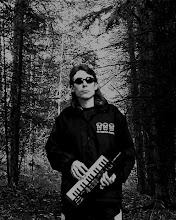
Vocaloid, in case you're not aware by now, is software developed by Yamaha that allows musicians to program vocal tracks for an ever-growing selection of virtual singers. Probably the most famous of these is a vocaloid called Hatsune Miku. It was a song by Miku (produced by Nayuta) called 'Silence' that first introduced me to vocaloid music. In fact it was the Nayuta vs TECHNiA remix, and that brings me to shu-t, who records as TECHNiA, Glint Of Sound, Feel The Sonic, and under his own name.
I found shu-t's album 'Various Feelings' on iTunes and it was the first vocaloid music I purchased. It showcases a varied selection of vocaloids so it serves as a good overview. The music is also fairly varied, while remaining in the techno arena. Vocaloids have been used on everything from garage-rock to symphonic music, but to me they're best suited to techno and trance, and that's why I think shu-t is one of the best vocaloid artists out there.
His basic setup is listed on his Myspace Page as the following:
Ableton Live 7, Image-Line FL Studio 8, Propellerhead REASON 3.0.
KORG Electribe MX, Kaossilator, Kaoss Pad 3, micro KONTROL.
reFX NEXUS2, KORG Legacy Collection - Digital Edition and Analog Edition 2007, YAMAHA VOCALOID, CELEMONY Melodyne.
I'll be featuring a selection of tracks by Shu-t, most of them uploaded to Youtube by the man himself, under the username: sonicwave2007. All videos are attributed to him unless otherwise noted.
Vox is a cool duet with some disco strings & house production. Watch out for the incredibly funky synth solos!
TECHNiA - Vox (vocals: Hatsune Miku, Meiko).
Unfortunately I couldn't find the album version of this remix, which is sung by Meiko and has much better fidelity. It's the most-played song on my iPod. The chorus lifts me into the stratosphere every time I hear it. I advise turning up your volume while listening:
Feel The Sonic - Whereabouts [TECHNiA remix] (Vocals: Megurine Luka) courtesy of Tatayatatana
This is quite anthemic. The album version also features Meiko so it has a little extra depth to the vocals. Another stunning solo played on a Korg Kaossilator:
Feel The Sonic - 4 Freedom (vocals: Luka Megurine)
Another stand out, this time with English lyrics throughout:
TECHNiA - Night of the Magic (vocals: Sweet Ann).
There are male vocaloids as well. To me they sound a little creepy. But the way "Gakupo/Gackpoid" is used in this track isn't bad (his vocal samples were provided by the popular Japanese singer Gackt).
Glint Of Sound - Cradle of Destiny [MG Style] (vocals: Meiko & Gakupo) courtesy of HatsuneMikuVocaloid2.
The following songs are from shu-t's album "AIMS." I'll start with an epic instrumental. A real stand out, and you can see some of his setup in the video.
shu-t - Delete Memory.
Megurine Luka was designed to sing in Japanese, but in this case she's singing English words. Not very intelligibly, it must be said, but vocaloids are such strange beasts that you can easily regard them as another instrument in the mix.
shu-t - Dream Grows (vocals: Megurine Luka).
Here's another track sung in English. If you click through to Youtube and view the video description you'll get the lyrics, which help a lot. It's obvious that English isn't shu-t's forte, but for me the mis-translation of the lyrics only adds to the appeal.
shu-t - Flaps The Wings (Vocals: Megurine Luka with Sweet Ann & Big Al).
I couldn't find the album version of this so here's an earlier version by TECHNiA. It's more dance-oriented than the album mix and has a different vocalist:
TECHNiA - @ Your Side (vocals: Sweet Ann).
Bonus track! The song that started it all. This is actually a mash-up of the original version of Silence by Nayuta and the remix by TECHNiA. Prepare for techno of incredible proportions!
Nayuta vs. TECHNiA - Silence [MMD Edition] (vocals: Miku Hatsune, Meiko) courtesy of kanna3939
I hope you've enjoyed at least some of these. Both "Various Feelings (shu-t's works)" and "AIMS" are available on iTunes in North America. I highly recommend them both.
I'd like to close by wishing everyone in Japan, including shu-t himself, the best in the wake of the recent disasters.
Showing posts with label Yamaha. Show all posts
Showing posts with label Yamaha. Show all posts
Saturday, March 19, 2011

Tuesday, January 27, 2009
The Alan Parsons Project - I Robot (1977)

Alan Parsons, an engineer at
On their next album, ‘I Robot,’ a funk-inspired affair, the synthesizer begins to play a larger role. It’s worth mentioning that a device called the Projectron was also used on this (and other APP albums). The Projectron was a one-off device created by Parsons himself:
“The Projectron was effectively an analog ‘sampler’. It could therefore produce any sound fed into it. It was a little like the Mellotron, but was capable of much higher quality. Usually it would reproduce tape loops individually recorded to a 16 or 24-track tape machine. The attack and decay times were adjustable using voltage control technology. One of the most featured sounds is the female background vocals on Breakdown. The Projectron looked something like a keyboard synthesizer but with lots of sockets on the front panel for connections to a multi track tape machine. Sadly, there are no known photos of it and it has disappeared into the annals of legend.”
The EMI Vocoder shows up on ‘The Voice’ (a track inspired by The Temptations’ ‘Papa Was A Rolling Stone’):
The Raven [from Tales of Mystery & Imagination] was the first rock song to feature a vocoder, which was designed by EMI's Research Laboratories. Eric Woolfson: "That's right, that was one of the earliest uses of vocoder. It was a machine that the EMI scientists had developed, a very cumbersome thing that was very much in its early stages. They had gotten it together in a way that let us do some relatively new things with it.”
This would be one of the rare occasions Alan can be heard doing 'lead vocals' in his career. "For The Raven it was not a real vocal sound at all, it was an electronic synthesis of my voice. I also did that electronic piece on The Voice ('he's gonna get you') [from I Robot]. The part on Time [from Pyramid] could be argued as a counter lead vocal. The real reason that I don't sing is that I don't think I'm a really good singer. Modesty prevents me from stealing any limelight. I'd much rather have people ask ‘why don't you sing?’, than 'why do you sing?’”
As for the synths used here, information is a little sketchy. Duncan Mackay played a Yamaha CS-50 or CS-60 (and a prototype CS-80 on subsequent albums); there may have also been an
*Thanks to Micke via the Vintage Synth Explorer forums for the interview excerpts.
The title track, an instrumental, opens the album. Some nice phased sweeps start things off, and a bubbly bass sequence propels the track along as various acoustic elements are added; including choir, cymbalom, and kantele.
I Robot, courtesy of unstoppable3rd
Next up, the otherworldy ballad "Some Other Time." The synthesizer parts here are such that they blend seamlessly with the orchestration. The most overtly synthetic-sounding part, ironically, appears to be guitar fed through an effects pedal.
Some Other Time, courtesy of leonheart54
'The Voice,' on which you can hear the EMI vocoder. This song was inspired by The Temptations' epic track 'Papa Was A Rolling Stone.' Well worth a listen if you enjoy this one.
The Voice, courtesy of colejordan123
The final track on the album is perhaps my favourite. My one complaint is that it's so short. Beautiful synth-work throughout, and the orchestra just tops it off. The concept here is an addendum to the Book of Genesis, in which robots, which we've created in our own image, inherit the earth.
Genesis Ch. 1 V. 32, courtesy of PARAFER2004
I could go on posting tracks from this album. There's the shimmering proto-ambient track 'Nucleus,' which I suspect features heavy use of the Projectron. There's the slide-guitar vs. synthesizer dreaminess of 'Day After Day.' There are the album's funkiest moments in 'I Wouldn't Want To Be Like You' and 'Breakdown,' which don't have much to do with synthesizers, but are fantastic tracks. Perhaps the only song I tend to skip is 'Total Eclipse' which is exactly the sort of dramatic music that should accompany an eclipse of the sun. Composed exclusively of choir and discordant strings, it doesn't make much sense alongside the other tracks unless you've listened to the 'Fall Of The House Of Usher' suite from the previous album. I hope, by hearing these excerpts, you'll be tempted to give I Robot a listen.
Monday, January 12, 2009
Elton John - Jump Up (1982)

While this is neither Elton John's most synth-heavy album, nor his finest usage of the synthesizer, it's special to me as the album that got me hooked on music as a kid. The song that stood out in particular was "I Am Your Robot," thanks, undoubtedly, to a fascination with robots fostered by TV shows such as Doctor Who, Metal Mickey, and The Goodies.
The album's liner notes state the synthesizers were provided by Yamaha, and played by James Newton-Howard. James has since gone on to do soundtrack work, notably the scores to M. Night Shyamalan's films and Batman Begins/The Dark Knight.
Elton John - I Am Your Robot
Courtesy of mrseltonjohn
The best song from the album for me these days is the single, "Empty Garden," a tribute to the late John Lennon. Some very nice understated synth work on this one.
Elton John - Empty Garden
Courtesy of 007koko007
One more for the road: "Princess," a ballad overlooked in favour of the "Blue Eyes" single, features a cheesy-but-fun synth-brass solo.
Elton John - Princess
Courtesy of mrseltonjohn
Saturday, January 3, 2009
The Doctor Who Theme
It would be remiss of me to start this blog without mentioning one of the most important pieces of electronic music in popular culture: the theme to Doctor Who. It's certainly what introduced me to the concept of synthesizers at an early age. Technically, it was created before synthesizers (as we know them today) existed; but nearly all elements of the tune were created by tone and white noise generators (oscillators, in effect), then processed and sequenced on tape machines. Composed by Ron Grainer and realized in 1963 by Delia Derbyshire at the BBC Radiophonic Workshop, it's a piece of music that still sounds fresh and haunting today. Indeed, elements of Delia's original are used in Murray Gold's current version of the theme.
Mark Ayres, former composer of incidental music for the show, curator of the Radiophonic Workshop archives, and the man in charge of audio-restoration for DVD releases of the classic series, has written an extensive article on the history of the Doctor Who Theme which is well worth a read.
Exhibit 1: The original theme, 1963. Courtesy of TheDoctor001
A classic clip of Delia Derbyshire at work. Courtesy of radioshaolin
Exhibit 2: Peter Howell's version, 1980. Courtesy of timelord726
Synths: Yamaha CS80, ARP Odyssey, EMS Vocoder, and Roland Jupiter 4.
The making of Peter Howell's version. Courtesy of thegreenman42
Exhibit 3: Dominic Glynn's version, 1986. Courtesy of timelord726
Synths: Roland Juno-6, Yamaha DX21, Korg 770.
Exhibit 4: Keff McCulloch's version, 1987. Courtesy of timelord726
Synths: Sequential Circuits Prophet 5.
These are by no means all versions of the Doctor Who theme. The original went through many subtle changes during the ten years it was used on the show, and there was even an aborted version Delia Derbyshire created on an EMS Synthi-100 (known as the "Delaware" version). Countless others have been produced throughout the years for audio-adventure releases, specials, etc... Not to mention the hundreds of fan-produced versions found at whomix.
Subscribe to:
Posts (Atom)